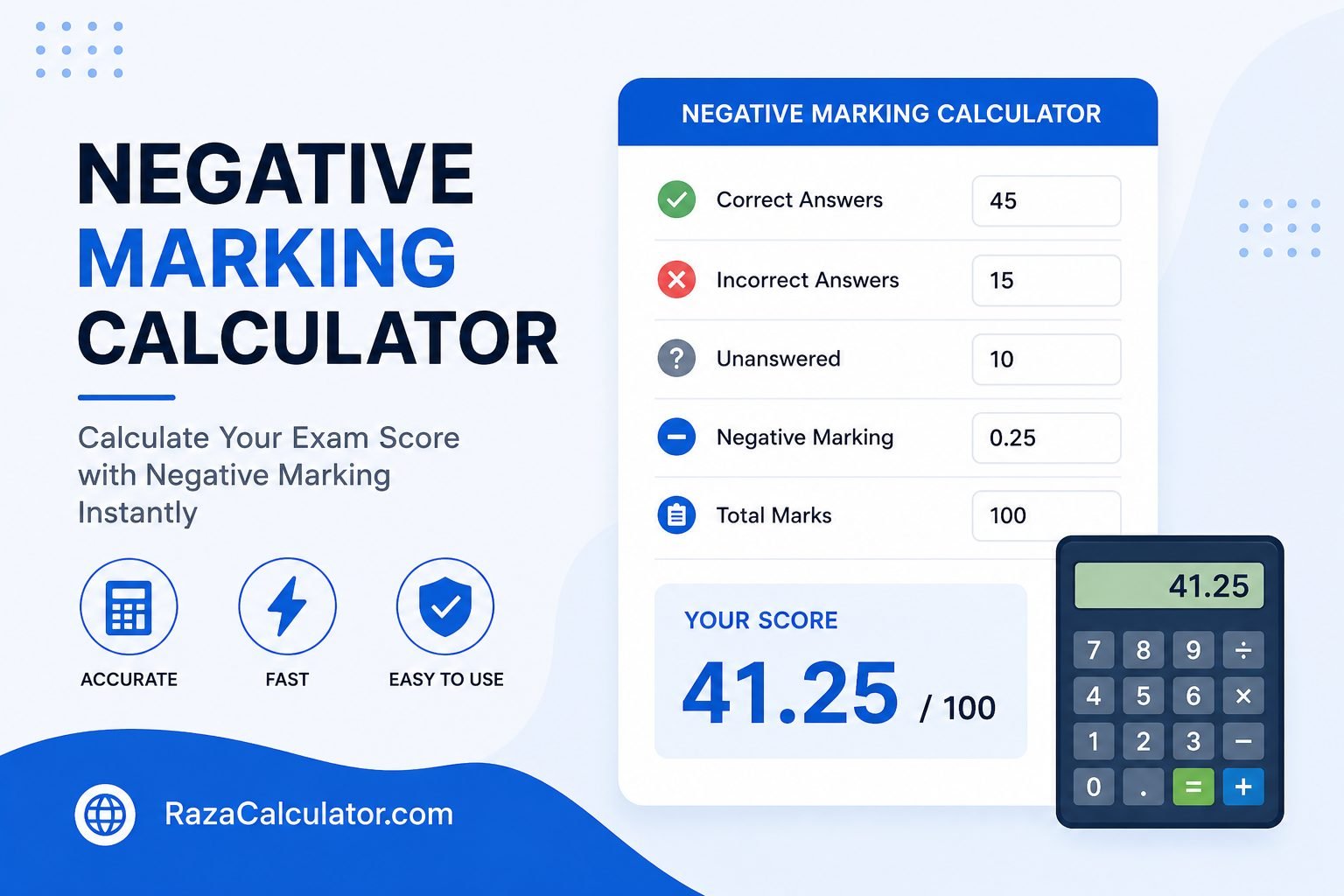
Negative Marking Calculator: Turn Raw Attempts Into a Real Net Score
Getting 80 questions right sounds strong, until the wrong attempts start subtracting marks one by one. This guide walks through exactly how that final net score gets built, penalty by penalty, and why two candidates with the same correct count can still end up ranked very differently.
About This Negative Marking Calculator
Most competitive exams in India — JEE, NEET, banking exams, UPSC prelims — don't just count correct answers. Every wrong attempt subtracts a fraction of a mark, which means two candidates with the identical number of correct answers can walk away with noticeably different final scores if one guessed more aggressively than the other. This tool takes total questions, correct answers, wrong answers, and the marking scheme in use, and returns the actual net score along with an accuracy percentage — the number that matters far more than a raw correct count on its own.
It also settles a question that trips up a lot of test-takers while they're still preparing: whether guessing is worth the risk on a given exam. Once the exact penalty ratio is visible against the reward for a correct answer, that decision stops being a gut feeling and becomes simple arithmetic.
Preparation strategy often shifts once this number becomes concrete. A candidate consistently scoring 85 raw correct answers might discover their actual net score sits closer to 70 once wrong guesses are penalised — a gap large enough to change which mock test results actually reflect real readiness, and which ones were quietly inflated by lucky guesses that happened to land. Tracking net score across every practice test, rather than just the correct count, tends to surface this gap far earlier than waiting for the real exam to reveal it.
How It Works
Behind the single net score, three separate figures get tracked: gross marks earned from correct answers, total penalty deducted from wrong ones, and questions left unattempted, which are simply excluded from both sides of the equation. Unattempted questions neither add nor subtract anything — they're the one category where staying silent genuinely carries zero cost, which is exactly why the guess-or-skip decision matters so much on any negatively marked exam. Different exams set their own penalty fraction, and getting that number right matters more than people expect:
| Exam Type | Typical Penalty |
|---|---|
| JEE Main | 1 mark deducted per wrong answer (4 awarded for correct) |
| NEET | 1 mark deducted per wrong answer (4 awarded for correct) |
| Bank PO / Clerk exams | 0.25 mark deducted per wrong answer |
| UPSC Prelims | Roughly 0.33 mark deducted per wrong answer |
How to Use This Tool
- Enter the total number of questions in the exam.
- Fill in how many you answered correctly and how many incorrectly.
- Set the marks awarded per correct answer and the penalty per wrong one.
- Read off the net score, gross marks, penalty deducted, and accuracy percentage together.
Formula and Penalty Comparison
The arithmetic itself is short: multiply correct answers by the marks each is worth, multiply wrong answers by the penalty, and subtract the second from the first. What changes the outcome dramatically is which penalty ratio applies. A penalty of 0.25 barely dents a strong attempt, while a full 1-mark penalty on the same attempt can erase a substantial chunk of the score earned from correct answers. Holding the same raw attempt — 60 correct, 20 wrong, out of 100 — steady and only changing the penalty shows how much that single number matters:
Same 60 correct, 20 wrong attempt — the net score drops from 60 to 40 purely based on which exam's penalty rule applies.
Features
- Custom positive and negative marking values, not locked to one exam's fixed rule
- Separates gross marks, penalty deducted, and net score clearly
- Accuracy percentage calculated only from attempted questions
- Free, browser-based, with no signup required
- Validates that correct plus wrong answers never exceed the total question count
- Shows unattempted questions separately, so nothing gets miscounted
Examples
Negative Marking Calculator FAQs
Yes, every marking scheme and question count is free.
Yes — the positive and negative values are fully customisable.
They're excluded entirely from both marks and penalty.
No — accuracy only looks at attempted questions, ignoring marks value.
Depends on the odds — check whether the expected gain from a lucky guess beats the expected penalty from a wrong one, especially if you can eliminate a couple of options first.
Yes, if penalties from wrong answers exceed marks earned from correct ones, which is common on exams with a 1-mark penalty and a low accuracy rate.
To discourage random guessing and reward genuine knowledge over chance, keeping the ranking closer to actual preparation level.
No — treat it as a close estimate for planning and self-assessment, not an official result, since some boards apply small scaling or normalisation adjustments afterward.
Final Word
A raw correct count only tells half the story once penalties enter the picture. Run your attempt numbers through this tool right after any mock test, and you'll see your real, exam-accurate score instead of an optimistic guess — and adjust your guessing strategy for the next attempt accordingly.
Try the Negative Marking Calculator Now