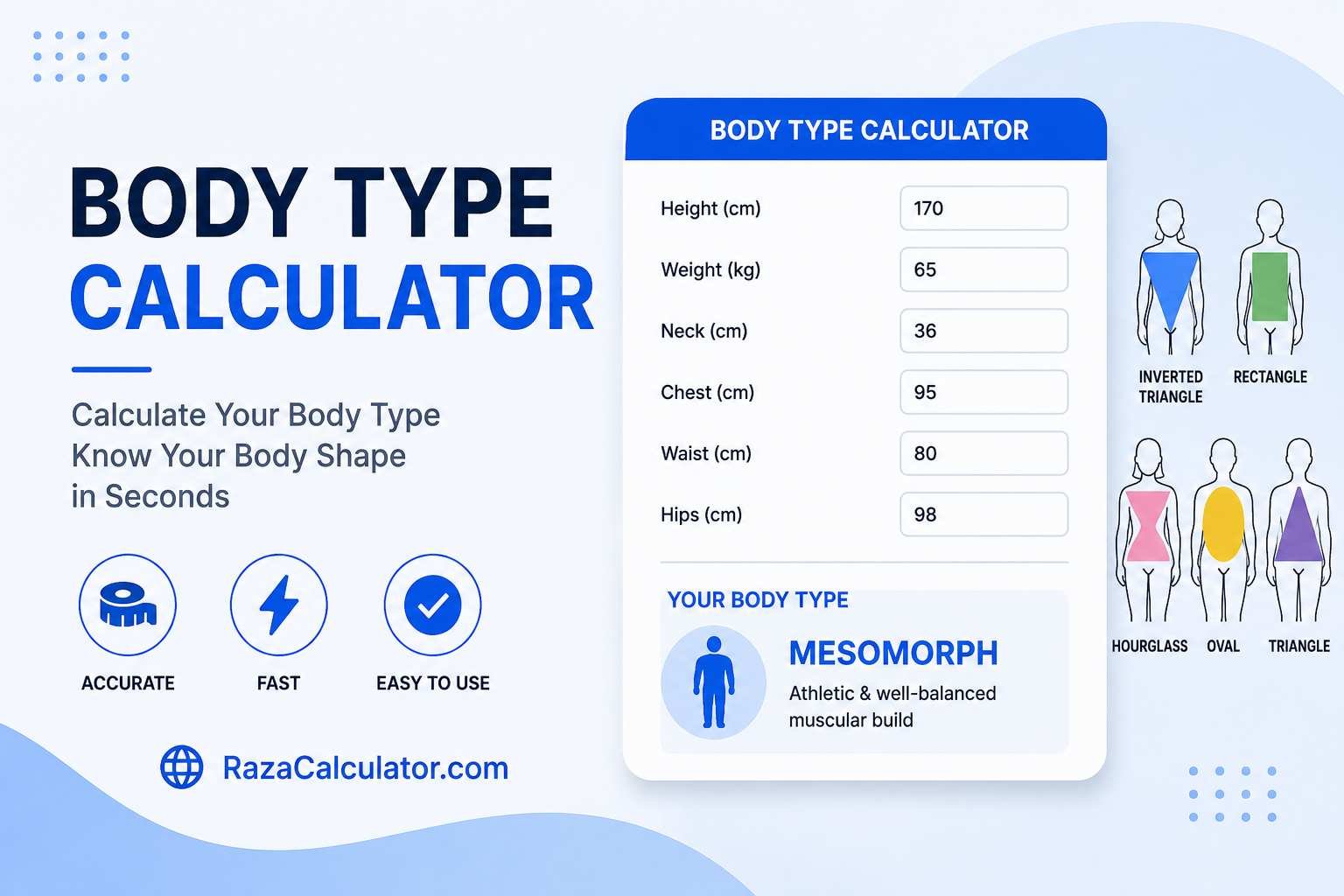
Body Type Calculator: Find Your Shape From Three Measurements
Bust, waist, and hip measurements, run through a few simple ratio checks, are enough to name a body shape and a waist-to-hip ratio. No scale, no BMI chart — just a tape measure, three numbers, and a comparison the tool handles automatically.
About the Body Type Calculator
Body shape classification isn't about a single measurement — it's about how three numbers relate to each other. A 36-inch bust means something different next to a 24-inch waist than it does next to a 34-inch waist. This tool compares bust, waist, and hip figures against each other, checks the gaps against standard anthropometric thresholds, and returns both a named silhouette category and a waist-to-hip ratio, a figure researchers have used for decades to describe body fat distribution.
None of the five categories — hourglass, pear, inverted triangle, rectangle, or apple — is treated as better or worse here. They're descriptive labels used in clothing fit guides and anthropometric research, not a judgment on health or appearance.
Waist-to-hip ratio itself has a longer research history than the shape labels do. Health researchers began using it decades ago as a simple, tape-measure-only way to estimate fat distribution without needing scans or specialised equipment, and it's still referenced today alongside — never instead of — a broader picture that includes activity level, family history, and overall health context.
How the Body Type Calculator Works
Underneath the label, the logic is comparative rather than absolute. The tool checks the gap between bust and hip first — if they're close, the waist becomes the deciding factor between hourglass and rectangle; if one clearly outsizes the other, that determines pear or inverted triangle instead. A waist that matches or exceeds both bust and hip pulls the result toward apple, regardless of how the other two compare to each other. Each threshold is checked in a fixed order, so a measurement set only ever lands in one category, even when it sits close to more than one rule at once.
How to Use This Body Type Calculator
- Pick inches or centimetres as your measurement unit.
- Measure bust at its fullest point, waist at its narrowest, and hips at their widest.
- Enter all three figures into the form.
- Read the named shape plus the waist-to-hip ratio shown alongside it.
Body Type Calculator Formula
Waist-to-hip ratio itself is simple — WHR = waist ÷ hip. Shape classification then layers a few comparative rules on top:
| Shape | Rule of Thumb |
|---|---|
| Hourglass | Bust ≈ hips, waist noticeably narrower than both |
| Pear | Hips clearly wider than bust, defined waist |
| Inverted Triangle | Bust/shoulders wider than hips |
| Rectangle | Bust, waist, and hips close in measurement |
| Apple | Waist equal to or larger than bust and hips |
Where Your WHR Sits
General population reference bands — not a diagnosis. Genetics, age, and muscle distribution all shift where an individual sits.
Features
- Works with either inches or centimetres, no manual conversion
- Returns both a named shape and a numeric WHR together
- Uses standard anthropometric thresholds, not a single arbitrary cutoff
- Free, private, and runs entirely in your browser
- Full breakdown of all three inputs shown alongside the final result
Examples
36–26–37 (in inches): bust and hips are close, waist sits well below both — this reads as hourglass, with a WHR around 0.70.
34–28–41: hips clearly outsize the bust by more than expected, with a defined waist — a pear result, WHR near 0.68.
32–33–34: all three figures sit close together — a rectangle result, with a WHR close to 0.97.
38–29–33: bust noticeably wider than hips, tapering waist — an inverted triangle result, WHR around 0.88.
Body Type Calculator FAQs
Is this tool free? Yes, every calculation and shape category is free to use.
Which measurement matters most? None alone — it's the relationship between all three that decides the shape.
Does a shape category mean I'm unhealthy? No — it's a descriptive silhouette label, not a health verdict on its own.
What does WHR actually measure? The ratio of waist circumference to hip circumference, used in research as one indicator of fat distribution.
Can my shape change over time? Yes — weight changes, muscle gain, age, and pregnancy can all shift the same three measurements, sometimes moving a result into a neighbouring category entirely.
Is centimetres or inches more accurate? Neither — the tool converts internally, so either unit gives an identical result.
Why do two similar-looking people get different labels? Small gaps between measurements can cross a threshold, so close cases sometimes land in neighbouring categories.
Should I use this for clothing sizing? It's a reasonable starting point for silhouette-based fit guides, though brand-specific size charts still vary.
Final Word
Three measurements, one comparison, one label — that's the entire tool in practice. Use it as a descriptive starting point for fit and proportion, not a verdict on how your body should look, and remember that the same three numbers can shift naturally over time.
More tools on razacalculator.com: TDS Calculator, TDS Calculator for Salary, Cut Off Calculator, and Engineering Cut Off Calculator.
Try the Body Type Calculator Now